
The prime minister's visit to Washington should focus more on shopping for energy security and stopping the US from snooping on us, reigning in its popular and innocuously operated instruments to gather intelligence like Google, says Tarun Vijay.

'I am quite optimistic that sooner or later, my wishful thinking would turn into a reality.' The only hitch is that the INC president's own career ambitions may be hurt if the Congress merges with the BJP,' says Sudhir Bisht.

Prime Minister Narendra Modi's spin doctors are on an overdrive these days to project him as a "tough talking" leader following a spate of critical media reports about his sudden silence on key issues, says rediff.com contributor Anita Katyal.

All the three issues raised by China at the Modi-Xi meeting are either intractable or peripheral to the bilateral relations and suggest conventional methods to placate the other side without yielding much, says Srikanth Kondapalli.

The Planning Commission has not been central to the policy making process since the mid-1960s, says Nitin Desai.
Nobody is clear what 'minimum government maximum governance' means.

It maybe time for the Centre to take a closer look at Chief Minister Jayalalitha's innovative' solution to a long-pending problem, says N Sathiya Moorthy.

The party has tried to downplay its vice-president's sudden move, saying he is the leader and will come back soon to play a pro-active role in party affairs

'Our first great challenge is to create 12 million new jobs each year, to make the demographic dividend an economic dividend.' 'We are nowhere near that,' points out Mohan Guruswamy.

Businessman P C Mustafa wants Indian Americans to return home, Cognizant CEO Francisco D'Souza outlines how Indian tech companies could grow, Gaurav Dalmia has some investment recommendations while Subramanian Swamy warns that India is flirting with a debt trap.

Union Minister Ravi Shankar Prasad has justified the Narendra Modi government's move to raise the rail fare by 14.2 per cent, saying it was a result of the policies undertaken by the previous United Progressive Alliance government. In an exclusive interview to CNN IBN, Prasad blamed the UPA II government for leaving Indian Railways in shambles, adding that his government never knew that the railways was bleeding, thanks to the Congress-led regime.

Rahul exuded confidence that his party will emerge victorious in Karnataka, Rajasthan, Madhya Pradesh and Chhattisgarh assembly polls and defeat the BJP in the 2019 general polls.

As West Bengal, Kerala, Assam, Tamil Nadu and Puducherry prepare for new administrations, one is reminded of the disparity that runs through the veins of the Indian states, notes Mihir S Sharma.

Attacking the note ban move, Yechury said the PM's assertion that it will impact terror funding has not yielded any result.

Modi government has to come up with a robust economic agenda to impress the masses.
The Modi PMO is like none other: It is staffed by people who are so low profile that the only dominant personality is the Prime Minister's.
The parliamentary clearance to the Land Boundary Agreement Bill has ensured that Prime Minister Narendra Modi gets the same tumultuous welcome which late Indira Gandhi received when she first visited Bangladesh after the liberation war in 1972

The prime minister came down heavily on the Congress government in Assam and the previous UPA government at the Centre for "failing" to fulfil dreams and aspiration of the people.

Any delay in passing the coal bill may cause a crisis in the coal sector which would also affect the power sector.

'India's biggest loss is that we will not have anyone as principled and as courageous as Rajan.'
Government's reforms are too half-hearted. But Rahul Gandhi's Congress is too amateurish and inept to hold it to account.

'Let us also not expect that there will be a clean break with the past, much though the new government might like to think about it. In a functional democracy that is neither feasible nor desirable. But basic change it must be,' says Shreekant Sambrani.

'A lot will depend on the first Aayog and the power it derives.'

'Sonia is trying to become a politician again. Will she succeed?'
Why is the BJP playing 'competitive politics' where there is scope or room for none? The release of 5 Indian fishermen on death row in Sri Lanka was a victory for India's quiet diplomacy of long years in the matter -- and not for loud politics by parties in the country.
'High denomination cash notes which was 1.4 lakh crores of Rs 500 and Rs 1,000 notes in 2004 became Rs 15.5 lakh crores in 2016.' 'If it had been allowed, by 2022, it would have been Rs 34 lakh crores, and that would have been the end of the Indian economy.' 'Demonetisation was a huge hit on the head of the economy, but without the hit, you could not U-turn the economy.'

'No PM has said no to anything we have proposed. I am not a politician and I cannot give speeches about things, but a lot of good things have been done in science by previous governments.' 'Under Dr Manmohan Singh, we could do a few important things. I used to meet him once in 6, 8 weeks. He often said, 'Professor Rao, you assume that you have my approval and carry on.' He was shy and decent. He is a real gentleman.' 'Science keeps me going at 80. I feel young.' Professor C N R Rao, the eminent scientist who was honoured with the Bharat Ratna, on the state of science in India.

The ongoing vicious game between Delhi and the so-called 'separatist' militias has severely blighted the Nagas' life and gutted their dignity, says Ravindra Narayan Ravi
The kind of people Narendra Modi has chosen, the decisions he has taken and the rail and central budgets suggests that he is treading carefully in New Delhi. There is less of innovation and more of continuity, so far. He is not ready to rock the boat and start from scratch, says Sheela Bhatt.
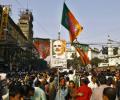
It has been said that by 2025, India could become among the top five economies in the world. If India does become a $5 trillion economy but gets all its rivers polluted, food chain poisoned and genetic pool depleted and biometric database of Indians sold or stolen at the behest of commercial czars, will it not be a pyrrhic economic victory, asks Gopal Krishna.

'Biometric Aadhaar-based surveillance is not only about violation of privacy, but also about the treasure hunt for unprecedented financial surveillance and economic intelligence in the economic history of mankind,' asks Gopal Krishna.

'15, 17 years back we were not even in existence in the US. Today nearly 1/3 of prescriptions written comes from India.' 'India is showing that in a very competitive environment -- like the US and Europe -- our industry is doing very well.'

How much money the Modi government has already spent and is going to spend on all those foreign trips, muses Sunita Iyer
Chartered accountant and commentator M R Venkatesh on why the GST Bill will cost the BJP dear.
Who are the men the prime minister relies on to execute his impressive agenda?
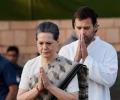
'According to a powerful section of the Congress the vote was anti-Congress, anti-dynasty and pro-Modi, in that order. They say Modi won because he represented and completely played upon "Bhartiyata".' 'Sonia is being accused, privately, of protecting her son at the cost of the party's interest.' 'For the first time ever, 24 Akbar Road, the Congress headquarters, is assessing the "neeyat (intent)" of the Gandhi Parivar, which has never happened before.' A Rediff Correspondent lifts the veil off the churning within the Congress party in the wake of the party's rout in the election.
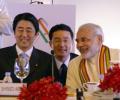
'Both nations have a common problem: A rampaging, jingoistic and hostile China which is making substantial territorial claims. In the long run, Japan and India are going to be the victims of Chinese aggression -- so they might as well hang together to contain China,' argues Rajeev Srinivasan.

'Growth is predicated on the misery of large sections of people.' 'Maybe Hindutva will be used to suppress any such unrest.'
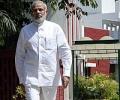
Naresh Chandra, former cabinet secretary, diplomat and well-known strategic thinker, tries to explain what the Modi government is up to and assesses what will work and what may not work and why. He spoke to Sheela Bhatt/Rediff.com, also, on diplomatic issues.
 © 2026 Rediff.com - Advertise with us - Disclaimer - Privacy Policy - Sitemap - Feedback - About us - Terms of use - Grievances